Title 24 lighting requirements for kitchen and bathroom remodels (2025)
California's residential lighting rules (Section 150.0(k)) require every permanently installed light to be JA8 high-efficacy. Kitchens and living spaces need dimmers, bathrooms need at least one light on a vacancy sensor, and recessed downlights can't use screw-in sockets.
Lighting is one of the easiest parts of Title 24 to get right, and one of the easiest to fail at inspection if you don’t plan for it. California’s residential lighting rules are in Section 150.0(k) of the Energy Code. They apply to new homes, ADUs and additions, and generally to new or replacement permanently installed lighting in a remodel.
Here is what the current (2025) rules mean for a typical kitchen, bathroom or whole-home remodel.
1. Every light must be high efficacy (JA8)
All permanently installed luminaires and light sources must meet Reference Joint Appendix JA8. JA8 is California’s standard for high-quality, efficient lighting. It covers efficacy and also color rendering, flicker, dimming and lifetime.
- Look for the “JA8” marking on the lamp or its packaging, or check that the product is listed as JA8-certified in the CEC’s Modernized Appliance Efficiency Database.
- Bulbs in enclosed or recessed fixtures must be rated for elevated temperatures. These carry an “E” (elevated temperature) designation in their JA8 marking.
- Exempt items include lights built into exhaust fans and range hoods, small night lights and navigation lights under 5 watts, and ceiling fan light kits covered by federal standards.
Almost all quality LED fixtures sold in California meet JA8, but not every cheap online import does. Check before you buy.
2. Recessed downlights: no screw-in sockets, and airtight
Recessed ceiling lights (can lights) must:
- Not have screw-based sockets. Use integrated LED fixtures or wafer lights instead.
- Be airtight, with leakage under 2.0 cfm at 75 pascals, and sealed with a gasket or caulk between the housing and ceiling.
- Be rated for contact with insulation (IC-rated) where insulation is present, per the California Electrical Code.
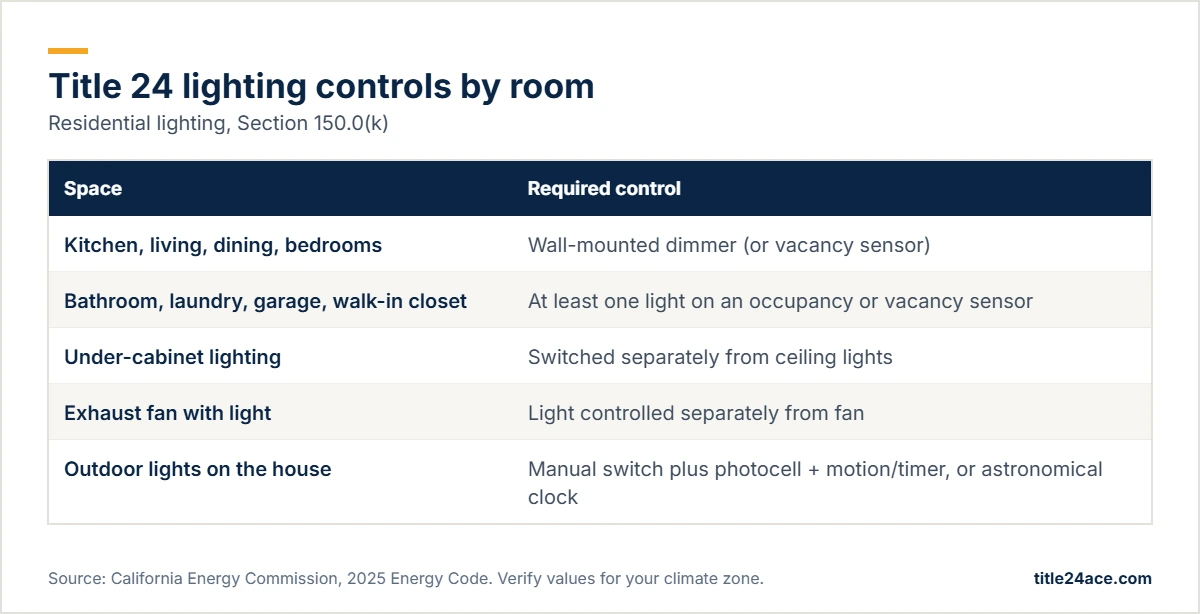
3. Controls: what each room needs
| Space | What Title 24 requires |
|---|---|
| All indoor lighting | Readily accessible wall-mounted on/off control |
| Kitchens, living rooms, dining rooms, bedrooms and other habitable spaces | Wall-mounted dimmers (or vacancy sensors). LED dimmers must be compatible (NEMA SSL 7A for phase-cut dimming) |
| Bathrooms, garages, laundry rooms, utility rooms, walk-in closets | At least one luminaire controlled by an occupancy or vacancy sensor that turns lights off automatically |
| Under-cabinet and display-cabinet lights | Controlled separately from the ceiling lights |
| Bathroom exhaust fan with a light | The light controlled separately from the fan |
| Cabinet and drawer lighting (opaque fronts) | Must turn off automatically when the door or drawer closes |
Exceptions apply. For example, very low-wattage circuits (under 20 W) and lights already controlled by a vacancy sensor don’t also need a dimmer.
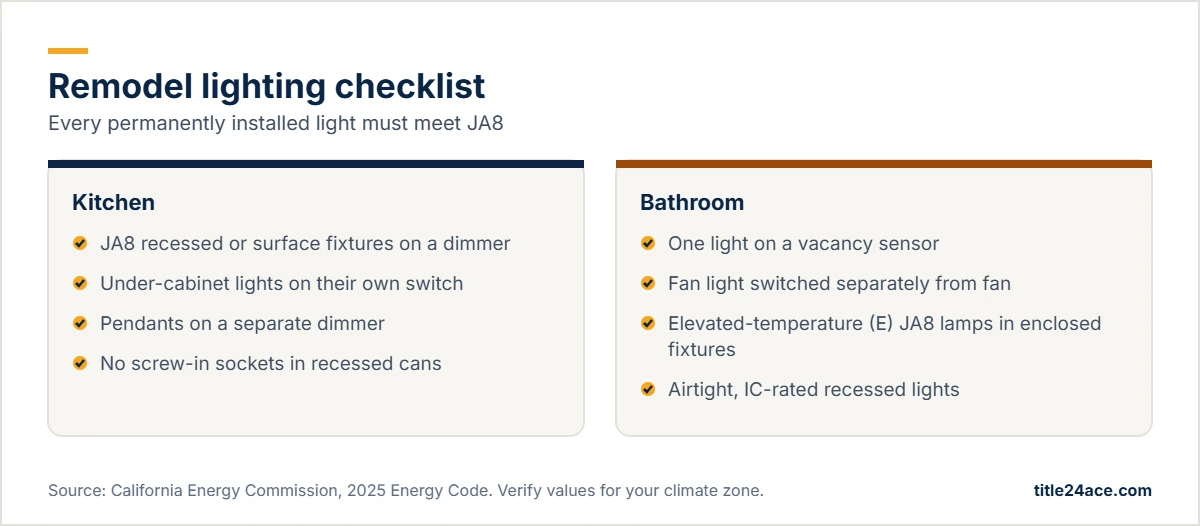
Kitchen remodel checklist
- JA8 recessed or surface fixtures on a dimmer
- Under-cabinet lighting on its own switch
- Pendant or island lights on a separate dimmer, if you want independent control
- Range hood light: exempt from JA8, but the hood itself has its own ventilation rules
Bathroom remodel checklist
- At least one light on a vacancy or occupancy sensor
- Exhaust fan light switched separately from the fan
- Elevated-temperature (E) rated JA8 lamps in enclosed vanity or shower fixtures
4. Blank ceiling boxes
Junction boxes more than 5 feet above the floor with no fixture installed (for a future fan or light, for example) are limited to the number of bedrooms. Each must be served by a dimmer, vacancy sensor, low-voltage wiring or fan speed control.
5. Outdoor lighting
Outdoor lights attached to the house must be high efficacy and have:
- a manual on/off switch, plus
- automatic control: a photocell combined with a motion sensor or time switch, or an astronomical time clock.
Override-to-on controls can’t keep lights on for more than six hours. Internally lit address signs must use 5 watts or less, or meet the sign requirements in the code.
6. Smart home systems
A home automation or energy management system can satisfy the control requirements if it provides the same functions, such as automatic shut-off and dimming, plus physical wall controls. It cannot be used to skip a required dimmer or sensor function.
How lighting shows up in your Title 24 report
Residential lighting requirements are mandatory measures. They apply whether you comply using the prescriptive or the performance approach, and they can’t be traded off against better insulation or windows. On the plans, they usually appear as mandatory-measure notes plus a lighting and switching layout. The inspector checks the installed fixtures and controls at final.
If your remodel also involves new windows, an HVAC changeout or an addition, those parts may need a full CF1R. Lighting is then documented as part of the same package.
Common lighting items that fail inspection
- Screw-in recessed cans. Retrofit trims in old screw-base housings don’t meet the “no screw-based sockets” rule for recessed downlights.
- No vacancy sensor in the bathroom. At least one bathroom light must turn off automatically. A plain toggle switch alone fails.
- Fan and light on one switch. Exhaust fans with lights need separate controls for each.
- Non-JA8 bulbs or fixtures. Bargain LED fixtures bought online often aren’t JA8-certified. Keep the spec sheets for the inspector.
- Wrong dimmer. LED fixtures need compatible dimmers. Flicker or buzzing is a sign of a mismatch, and inspectors may ask for proof that the dimmer is compatible.
Frequently asked questions
Does a kitchen remodel need a Title 24 report?
New or replacement permanently installed lighting must meet the residential lighting rules, which are shown as mandatory-measure notes on the plans. A full modeled CF1R is usually needed only if the remodel also changes the envelope, the HVAC or the water heating.
Are smart switches allowed?
Yes, if they provide the required functions, such as dimming or automatic shut-off, and there are still physical wall controls.
Do I need a vacancy sensor in every bathroom?
At least one luminaire in each bathroom must be controlled by an occupancy or vacancy sensor.
Need Title 24 documents for your remodel?
Title24 Ace prepares residential Title 24 reports for remodels, additions and new homes across California, with the mandatory lighting notes ready to drop onto your plans. Get an instant estimate.
This article summarizes California residential lighting requirements in Section 150.0(k) of the Energy Code. It is general guidance. Check your plans with your energy consultant, and note that local amendments may apply.
Related reading
This article is general information, not professional or legal advice. Always confirm requirements with your building department.
Ready to get your Title 24 report?
Upload your plans in minutes. We’ll handle the modeling, the forms and the plan-check revisions.