Replacing your AC or furnace? Title 24 HVAC changeout requirements for 2025
In California, replacing an AC, furnace or heat pump is an alteration that needs a permit. Even swapping only the outdoor or indoor unit triggers duct leakage testing (10% total or 7% to outside) and, for heat pumps, refrigerant charge verification by an ECC-Rater.
Swapping out an old air conditioner, furnace or heat pump feels like a simple equipment job. In California, though, an HVAC changeout is an alteration under the Energy Code (Title 24, Part 6). It usually needs a permit, testing and third-party verification. Skipping those steps is one of the most common reasons HVAC jobs fail final inspection.
Here is what the 2025 Energy Code (in effect for permits applied for on or after January 1, 2026) expects when you replace a residential HVAC system.
Do you need a permit to replace HVAC equipment?
Yes. The California Energy Commission (CEC) states that installing any space-conditioning appliance other than a plug-in unit requires a building permit. That covers:
- Replacing a split-system air conditioner or heat pump (outdoor unit, indoor unit, or both)
- Replacing a gas furnace or air handler
- Installing a ductless mini-split
- Replacing or extending ductwork
Plug-in window and portable units are the main exception. They can be installed without the full alteration rules, as long as they meet state and federal efficiency standards.
Changing just one part still triggers the rules
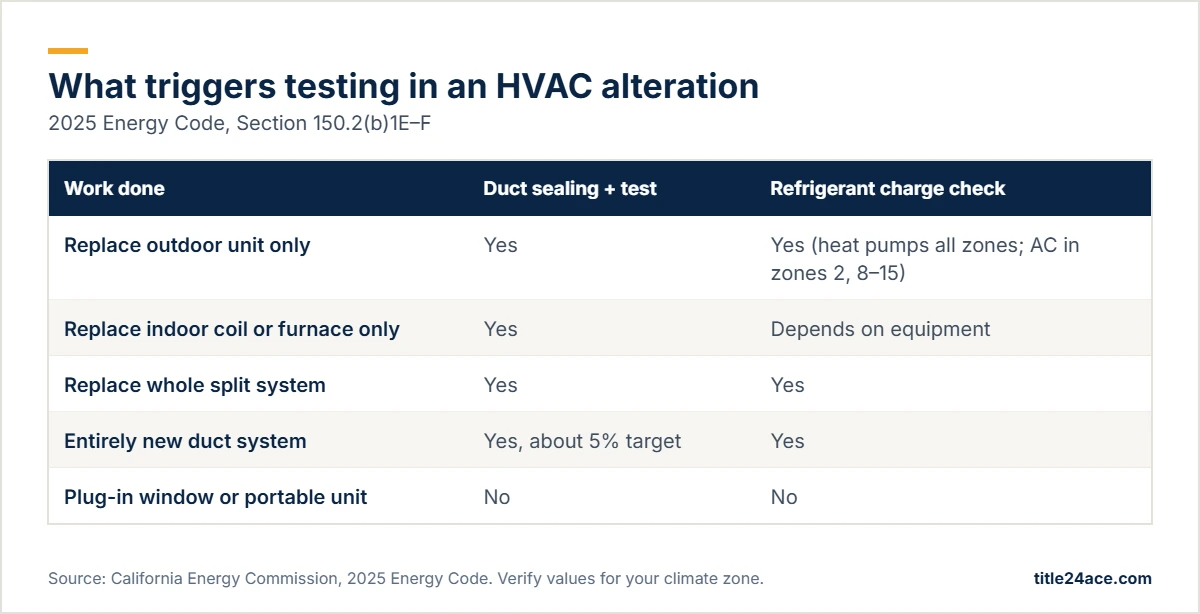
A frequent surprise: replacing only the outdoor condenser or only the indoor coil or furnace of a split system is still an altered system. The CEC is explicit that replacing either the outdoor or indoor unit of a split system “will trigger the duct sealing and field verification requirements” in Section 150.2(b)1E.
Duct leakage testing
When the existing ducts stay in place, the installer and an ECC-Rater (formerly called a HERS Rater) must test them. Under the 2025 code the ducts must show:
- 10% or less total leakage (tested per RA3.1.4.3.1), or
- 7% or less leakage to outside (RA3.1.4.3.4)
If the ducts can’t reach either target after reasonable sealing, the ECC-Rater can verify that all accessible leaks were sealed using a smoke test and visual inspection (RA3.1.4.3.5).
The code has long exempted some situations, such as very short duct systems (less than 40 linear feet), ducts already sealed and documented, and ducts made with or insulated with asbestos. Your energy consultant will confirm which exceptions apply to your home.
New or extended ducts
If you replace the whole duct system, the target gets tighter (about 5% leakage for an entirely new system). New ducts in attics, crawlspaces or other unconditioned spaces must meet the prescriptive insulation levels. If any duct is extended, the CEC notes the entire system has to meet the duct requirements.
Refrigerant charge verification
An under- or over-charged system can waste a lot of energy without anyone noticing. For new HVAC systems, the 2025 code requires refrigerant charge verification:
- for heat pumps in all climate zones (new for 2025), and
- for air conditioners in climate zones 2 and 8–15.
The installer charges the system to the manufacturer’s specifications, and the charge is then verified through a standard charge test, weigh-in charging, or a fault indicator display, depending on the equipment. Airflow across the coil is also typically checked in the hotter climate zones.
Replacing a system also requires refrigerant recovery by a technician with an EPA Section 608 Type II or Universal certification.
Thermostats and controls
When the system is altered, the thermostat usually has to be replaced with a setback thermostat that meets the code. The 2025 code also adds specific control requirements for heat pumps with backup electric resistance heat. These keep the backup heat from running when the heat pump alone can do the job.
Heat pump or AC: do you have to switch?
Statewide, the 2025 Energy Code makes heat pumps the prescriptive baseline for new homes. For an alteration, it does not force every AC replacement to become a heat pump. However:
- Several cities have adopted local reach codes that do. Menlo Park, for example, requires a heat pump when an AC condenser is replaced, with limited hardship exceptions.
- Utility and state rebates (such as TECH Clean California) often make a heat pump the cheaper choice.
Always check your city’s local amendments before choosing equipment.
Who is the ECC-Rater, and what paperwork is involved?
From January 1, 2026, California’s HERS program became the Energy Code Compliance (ECC) program. ECC-Raters are independent third parties who verify the testing the installer reports. A typical HVAC changeout involves:
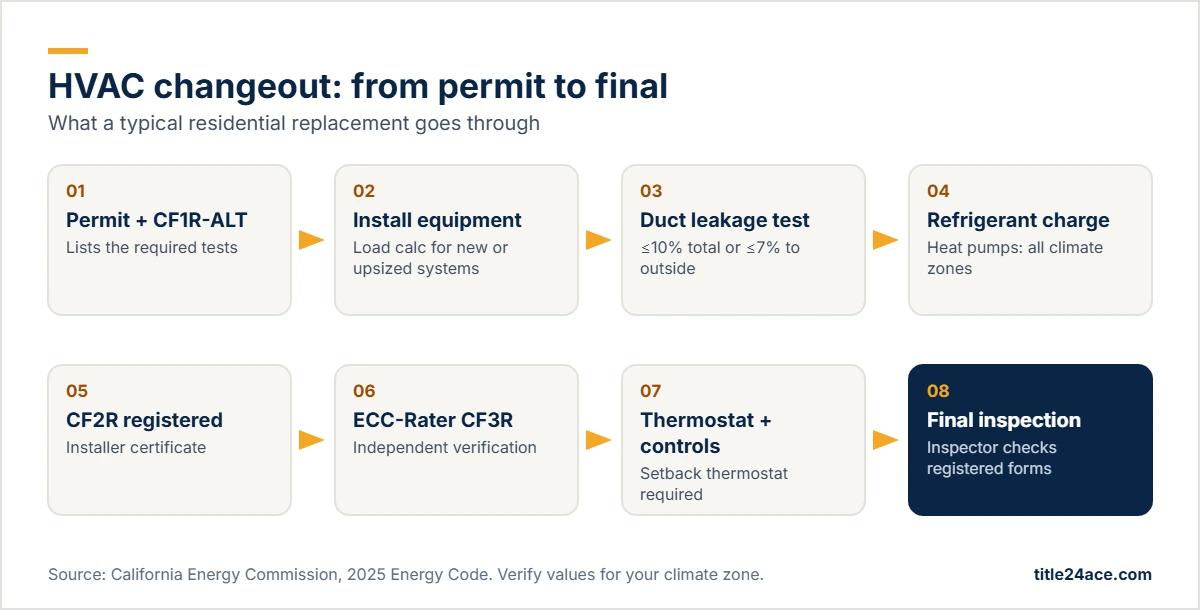
- CF1R-ALT – the Certificate of Compliance for the alteration, listing the required tests (prepared before or at permit).
- CF2R – the installer’s Certificate of Installation, entered in an ECC data registry.
- CF3R – the ECC-Rater’s Certificate of Verification after field testing.
The building inspector generally won’t sign off the final inspection until the registered CF2R and CF3R forms are complete. Read more in our guide to ECC verification.
Worked example: replacing an AC with a heat pump
A homeowner in Riverside (climate zone 10) replaces a 20-year-old 3-ton air conditioner and gas furnace with a 3-ton heat pump on the existing attic ducts:
- The contractor pulls a mechanical permit. The energy consultant prepares a CF1R-ALT listing duct leakage testing and refrigerant charge verification.
- After installation, the ducts test at 14% total leakage. The crew seals accessible joints and boots, and the retest comes in at 9%, under the 10% target.
- The installer charges the system and registers the CF2R. The ECC-Rater verifies the charge and duct results and registers the CF3R.
- The inspector signs off once both registered forms show complete.
If the ducts had stayed above 10% total and 7% to outside even after sealing, the ECC-Rater could have verified that all accessible leaks were sealed using a smoke test instead.
Common reasons HVAC permits fail
- Ducts in an old attic that can’t reach 10% leakage, with no smoke-test documentation
- The ECC-Rater was booked after the drywall or attic access was closed
- No load calculation for a new or upsized system (the 2025 code expects systems to be sized per ACCA methods)
- A heat pump installed without the required refrigerant charge verification
Frequently asked questions
Do I need a Title 24 report to replace my AC condenser only?
Yes. Replacing only the outdoor unit of a split system is an altered system under Section 150.2(b), so duct sealing and field verification still apply.
How long does ECC verification take?
A duct leakage test and refrigerant check usually take one to two hours on site. Booking the ECC-Rater for the day the system is started up saves a second trip.
Can I install a mini-split myself?
A permit is still required. Because most DIY split systems are connected on site, the CEC notes that refrigerant charge verification applies.
Need a CF1R for your HVAC replacement?
Title24 Ace prepares Title 24 documents for HVAC replacement projects anywhere in California, including performance models when a changeout is part of a remodel or addition. Get an instant estimate and upload your equipment details to get started.
This article is general guidance based on California Energy Commission resources for the 2025 Energy Code. Local reach codes may add requirements, and your building department has the final say.
Related reading
This article is general information, not professional or legal advice. Always confirm requirements with your building department.
Ready to get your Title 24 report?
Upload your plans in minutes. We’ll handle the modeling, the forms and the plan-check revisions.