Title 24 window replacement requirements in California (2025 Energy Code)
Replacement windows in California must meet the 2025 Energy Code: a maximum U-factor of 0.27 or 0.30 depending on climate zone, an SHGC of about 0.23 in cooling zones, and a mandatory 0.40 cap everywhere. Replacing 75 sq ft or less allows U-0.40 and SHGC 0.35.
Window replacement is one of the most common home projects in California, and one of the most common reasons homeowners first run into Title 24. If you swap out windows or sliding glass doors, the new products have to meet the energy performance limits in the California Energy Code (Title 24, Part 6). For permits applied for on or after January 1, 2026, that means the 2025 Energy Code.
This guide explains what the code checks, the numbers that usually apply, and how to get through plan check without delays.
Do window replacements need a permit and Title 24 compliance?
In most California cities and counties, yes. Replacing windows is treated as an alteration to an existing building, and Section 150.2(b) of the Energy Code sets the rules for altered fenestration (windows, glazed doors and skylights). Your building department will usually ask for one of two things:
- A simple prescriptive form showing each new window meets the maximum U-factor and SHGC for your climate zone, or
- A performance (computer-modeled) CF1R when the windows don’t meet the prescriptive limits, or when the window work is part of a larger remodel or addition.
Many jurisdictions publish their own one-page window change-out handout. It is worth checking it, because some cities and counties add local requirements on top of the state code.
The two numbers that matter: U-factor and SHGC
Every window certified by the National Fenestration Rating Council (NFRC) carries a label with two key ratings:
- U-factor – how easily heat passes through the whole window. Lower is better.
- SHGC (Solar Heat Gain Coefficient) – how much of the sun’s heat gets in. Lower means less summer heat gain.
Title 24 sets a maximum for each, and the limit depends on your California climate zone.
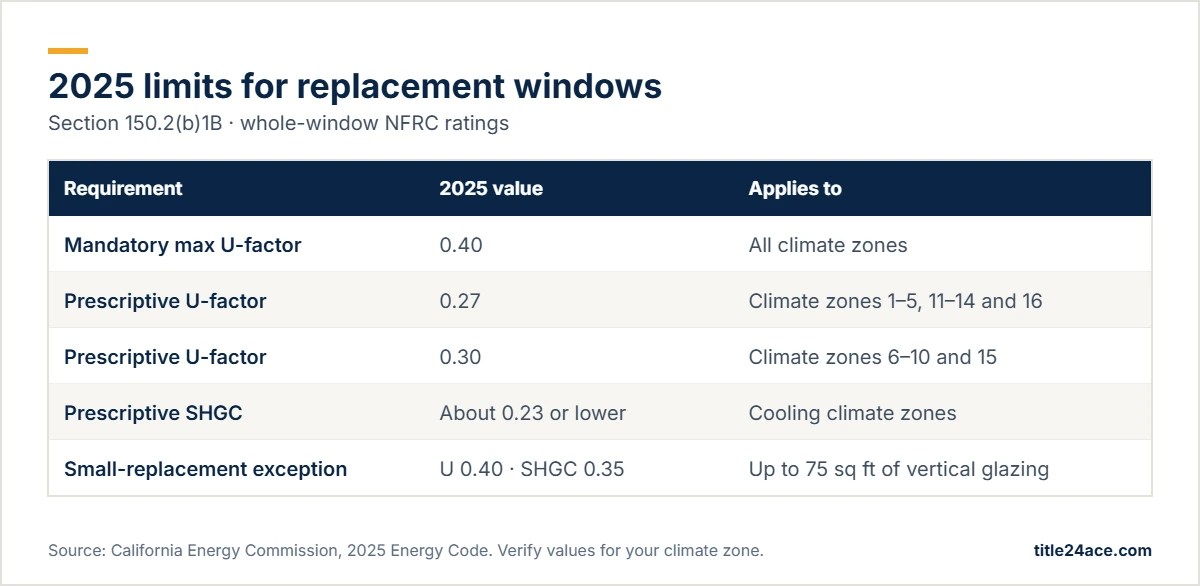
2025 limits for replacement windows
Under Section 150.2(b)1B, replacement windows generally have to meet the same prescriptive values as new construction in Table 150.1-A. For the 2025 code, the California Energy Commission summarizes those values as:
| Item | 2025 requirement |
|---|---|
| Mandatory maximum U-factor (all zones) | 0.40 (tightened from 0.45) |
| Prescriptive U-factor, climate zones 1–5, 11–14 and 16 | 0.27 |
| Prescriptive U-factor, climate zones 6–10 and 15 | 0.30 |
| Prescriptive SHGC, cooling climate zones | Typically 0.23 or lower (confirm the value for your zone) |
In practice, that means a standard dual-pane, low-E window that would have passed a few years ago may now be too leaky in the colder and inland zones. Many local handouts now simply state “U-0.27 or better” or “U-0.30 / SHGC 0.23” for their area.
The small-project exception (75 square feet)
If you are replacing 75 square feet or less of vertical glazing, the code allows relaxed values: a maximum U-factor of 0.40 in all climate zones and a maximum SHGC of 0.35 in climate zones 2, 4 and 6–15. This helps when you’re only swapping one or two windows and want them to match the rest of the house.
Skylights
Replacement skylights have their own, less strict limits. Historically, the code has allowed replacement skylights with a U-factor up to 0.55 and an SHGC up to 0.30. Check the current values with your energy consultant before you order.
Same size vs adding new window area
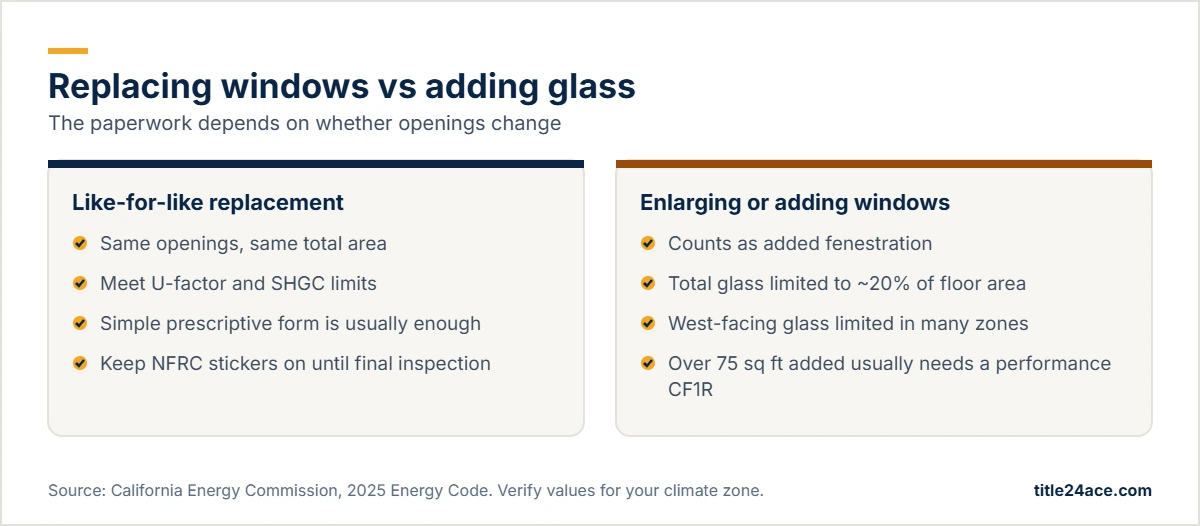
There is an important difference between replacing windows and adding window area:
- Like-for-like replacement – the new windows go in the same openings with the same total area. You just need to meet the U-factor and SHGC limits.
- Enlarging openings or adding windows – this counts as added fenestration. The total glass area of the house is limited (20% of floor area prescriptively, with a 5% limit on west-facing glass in many zones). Adding up to 75 sq ft is exempt from those area limits, but larger additions often need a performance model.
When you need a modeled Title 24 report
A computer-modeled (performance) report is the usual answer when:
- The windows you want, such as large lift-and-slide doors, steel windows or historic replicas, don’t meet the prescriptive U-factor or SHGC.
- You are adding a lot of new glass area, especially facing west.
- The window work is part of a remodel, an addition or an ADU.
The model lets better-performing items elsewhere, such as added insulation or more efficient HVAC, offset windows that fall short. That is often cheaper than switching to a premium window line.
What to send your energy consultant
- A floor plan or sketch showing each window’s location, size and the direction it faces
- The NFRC U-factor and SHGC for the products you plan to buy (from the quote or spec sheet)
- Whether openings are the same size or being enlarged
- The project address, so the climate zone and any local amendments can be confirmed
See our full document checklist for larger projects.
Tips to avoid plan-check delays
- Check the NFRC label before you order. Confirm U-factor and SHGC against your climate zone, not just “dual pane low-E.”
- Keep the stickers. Many inspectors want to see the NFRC labels on the installed windows, so don’t peel them off until after the final inspection.
- Use whole-window ratings. Center-of-glass values look better than whole-unit ratings, but they are not what the code uses.
- Ask about local rules. Some jurisdictions add requirements on top of the state Energy Code.
Worked example: a sliding door and three windows
Say a homeowner in Sacramento (climate zone 12) replaces a 6-foot sliding glass door (about 40 sq ft) and three bedroom windows (about 12 sq ft each). That is roughly 76 sq ft of glazing in the same openings:
- Because the total is just over 75 sq ft, the small-project exception doesn’t apply. Each product needs to meet the prescriptive values for zone 12: a U-factor of 0.27 or lower, plus the SHGC limit.
- If the door the owner wants is rated U-0.30, the choices are to pick a better-rated door, to replace one window later as a separate small project, or to model the whole house with a performance CF1R.
- With the performance approach, existing attic insulation or a recent HVAC upgrade can often make up the difference. The owner then keeps the door they chose.
The same project in San Diego (climate zone 7) would be held to U-0.30, so the U-0.30 door would usually pass without a model.
Common plan-check mistakes with window permits
- Using center-of-glass numbers. Quotes and brochures often list the glass rating. The code uses the whole-window NFRC rating, which is usually worse.
- Not listing each window. Inspectors want a schedule with size, orientation, U-factor and SHGC for every opening.
- Forgetting the climate zone. A window that passes in San Diego can fail in Sacramento or Fresno.
- Enlarging openings without saying so. Even a few extra square feet turns a replacement into added glass and can change the compliance path.
- Removing the labels too early. Without the NFRC sticker, the inspector may ask for spec sheets or delay the final.
Get your window replacement report
Title24 Ace prepares Title 24 compliance documents for window replacement projects across California, from a single sliding door to a whole-house retrofit. Use our price estimator, upload your window schedule, and you’ll usually have permit-ready documents in 2–3 business days.
This article is general guidance based on California Energy Commission summaries of the 2025 Energy Code. Requirements can vary by jurisdiction, and the building department makes the final call on your permit.
Related reading
This article is general information, not professional or legal advice. Always confirm requirements with your building department.
Ready to get your Title 24 report?
Upload your plans in minutes. We’ll handle the modeling, the forms and the plan-check revisions.