HERS is now ECC: California’s 2025 field verification program explained
Under the 2025 Energy Code, California's HERS program became the Energy Code Compliance (ECC) program on January 1, 2026. ECC-Raters still field-verify items like duct leakage, refrigerant charge and insulation, registering a CF3R before the building department signs off.
If you’ve built or remodeled in California before, you have probably heard of the HERS Rater, the independent tester who checks duct leakage, refrigerant charge and other items before the building department signs off. Under the 2025 Energy Code, that program has a new name and a stronger rulebook. It is now the Energy Code Compliance (ECC) program, and the testers are ECC-Raters.
Here’s what changed, what an ECC-Rater actually checks, and how to keep verification from holding up your final inspection.
What changed from HERS to ECC?
According to the California Energy Commission (CEC), the former HERS program for Title 24 compliance moved into Title 24, Part 1 and was renamed the Energy Code Compliance program. It applies to projects permitted under the 2025 Energy Code, which took effect on January 1, 2026.
The core job hasn’t changed: a certified third party verifies that energy features were installed and perform as the Certificate of Compliance says. What’s new:
- New titles: ECC-Provider (the approved data registry organization), ECC-Rater, ECC-Rater Company and Exemplary ECC-Rater.
- Conflict-of-interest safeguards: clearer rules keep raters independent from the contractors whose work they check.
- Stronger quality assurance: more structured on-site and data audits of rater work.
- Consumer protections: building owners receive a Consumer Information Form explaining the program and how to file a complaint, plus a report summarizing the compliance work done.
- Updated training: raters must complete training on every field verification and diagnostic testing (FV&DT) protocol they perform.
Existing registries, such as CHEERS, continue as approved ECC-Providers, so for most project teams the day-to-day workflow looks familiar.
Which projects need ECC verification?
Field verification applies mainly to single-family homes and low-rise multifamily buildings (three habitable stories or fewer). That includes:
- New homes and ADUs
- Additions
- Many alterations, especially HVAC replacements and duct work
For high-rise multifamily (four or more stories), most testing is done by the installing contractors through acceptance testing instead, except for some indoor air quality items.
What does an ECC-Rater test?
The exact list comes from your Certificate of Compliance (CF1R). The CF1R names every measure that needs field verification. Common items include:
| Measure | What’s checked |
|---|---|
| Duct leakage | Pressure test of the duct system against the leakage target (for example 10% total or 7% to outside for altered systems) |
| Refrigerant charge | Correct charge in AC and heat pump systems. For 2025, heat pumps need verification in every climate zone |
| Airflow and fan watt draw | Enough airflow across the coil, and fan energy use within limits |
| Ducts in conditioned space | Confirms ducts and air handlers are inside the thermal envelope when the design relies on it |
| Whole-house ventilation | Mechanical ventilation airflow meets the required rate |
| Kitchen range hood | Rated airflow or capture efficiency, and correctly sized ducting |
| Building air leakage | Blower-door test when the model takes credit for a tight envelope |
| Quality insulation installation (QII) | Insulation installed without gaps or compression, inspected before drywall |
| HRV/ERV fault indicators | New for 2025: fault indicator displays on heat or energy recovery ventilators |
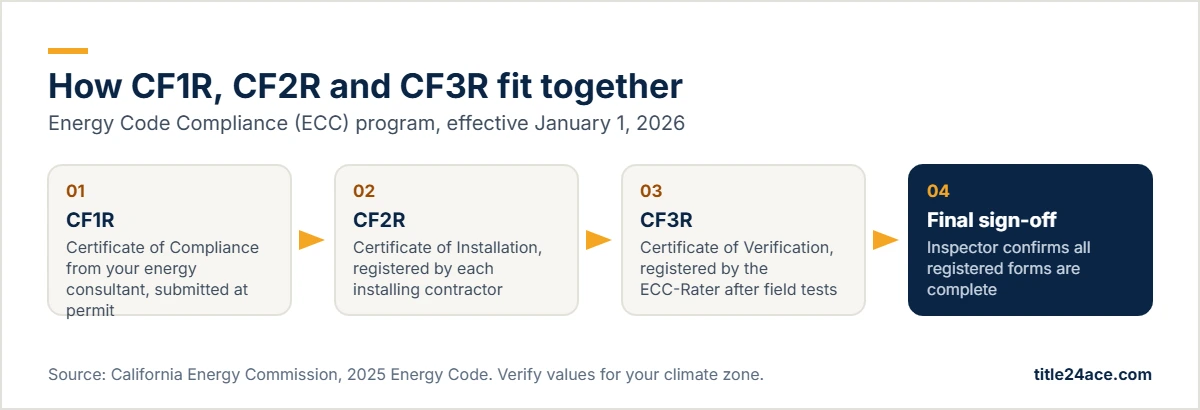
How the forms fit together: CF1R, CF2R, CF3R
- CF1R – Certificate of Compliance. Prepared by the energy consultant during design and submitted with the permit. It lists which measures need ECC verification. (New to this? Read What is a CF1R?)
- CF2R – Certificate of Installation. Completed by the installing contractor (HVAC, insulation, windows and so on) and registered in the ECC-Provider’s data registry.
- CF3R – Certificate of Verification. Completed by the ECC-Rater after the field tests, and also registered.
The building inspector checks that the registered forms are complete before giving final sign-off. Missing or mismatched forms are one of the most common reasons a finished project can’t close out its permit.
Timing: when to book the ECC-Rater
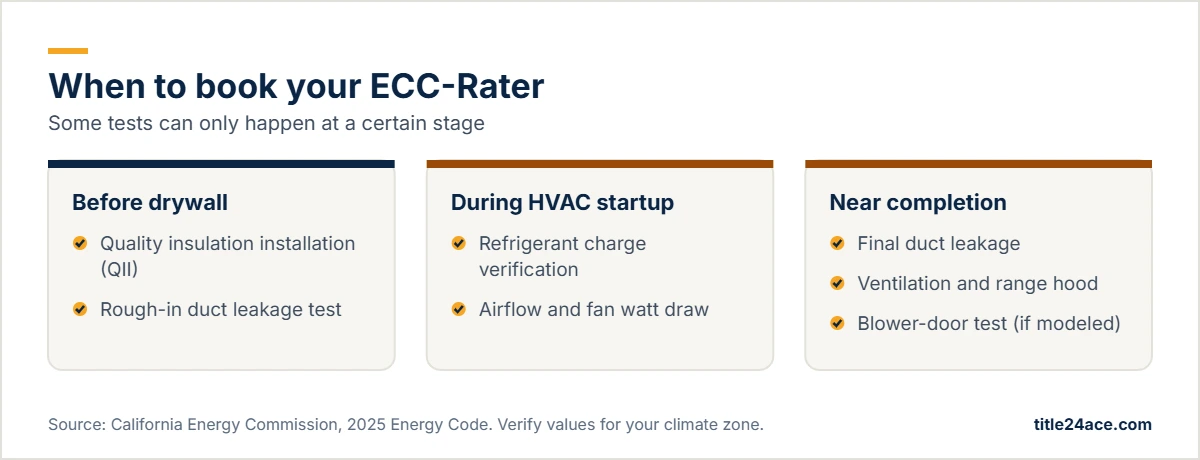
Some tests have to happen at a specific stage of construction, so book your rater early:
- Before drywall: QII insulation inspection, and often a rough-in duct leakage test.
- During HVAC startup: refrigerant charge verification is easiest while the installer is on site.
- Near completion: final duct leakage, airflow, ventilation, range hood and blower-door tests.
If a test fails, the contractor fixes the issue and the rater retests. Building in a few days of buffer before your final inspection helps a lot.
How to find an ECC-Rater
The CEC publishes a list of approved ECC-Providers, and each provider has a directory of certified raters. Your HVAC or insulation contractor may already work with one. Under the new conflict-of-interest rules, the rater must remain independent of the work being checked.
Common ECC verification problems, and how to avoid them
- Insulation covered before the QII inspection. If drywall goes up first, the rater can’t verify the insulation, and the model may have to drop the QII credit. That can cause the whole project to fail compliance.
- CF2R not registered. The rater can’t complete the CF3R until each installer has registered their CF2R in the same ECC-Provider registry.
- Wrong registry. The CF1R, CF2R and CF3R must all live in one ECC-Provider’s registry. Mixing providers stalls the final.
- Design changed after permit. If equipment, windows or insulation change, the CF1R must be revised so the tests match what was built.
- No retest buffer. A failed duct or blower-door test needs a fix and a retest. Leave a few days before the final inspection.
Frequently asked questions
Is a HERS Rater the same as an ECC-Rater?
The role is essentially the same. Under the 2025 Energy Code, the program was renamed the Energy Code Compliance (ECC) program, and raters are now called ECC-Raters, with updated training and stronger quality assurance.
Who pays for ECC verification?
Usually the owner or the contractor, depending on the contract. The rater is hired separately from the Title 24 report and must stay independent of the installers.
Does every project need an ECC-Rater?
No. Only projects whose CF1R lists field-verified measures need one. These are common for HVAC work, new homes, ADUs and additions.
How Title24 Ace helps
A clear, accurate CF1R makes ECC verification straightforward. Every test is listed up front, so your contractors and rater know exactly what to prepare. Title24 Ace prepares residential, ADU and multifamily (LMCC) compliance documents across California. Get an instant estimate to start.
This article summarizes California Energy Commission information about the ECC program under the 2025 Energy Code. It is general guidance, not legal advice. Your building department makes the final determination on your project.
Related reading
This article is general information, not professional or legal advice. Always confirm requirements with your building department.
Ready to get your Title 24 report?
Upload your plans in minutes. We’ll handle the modeling, the forms and the plan-check revisions.