California has required solar on most new homes since 2020, and the 2025 Energy Code (effective for permits applied for on or after January 1, 2026) updates how much solar is needed. It also makes new homes battery-ready and continues the solar-plus-battery requirements for many multifamily and commercial buildings.
Here’s a plain-English guide to who needs what.
Does my project need solar?
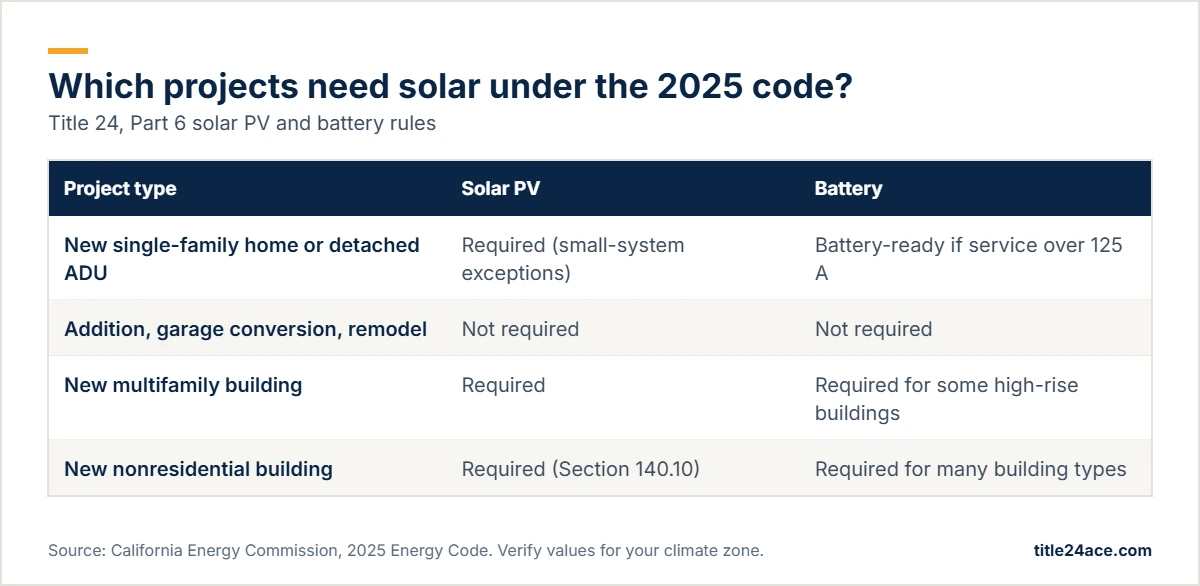
Title 24 solar requirements apply mainly to newly constructed buildings:
- New single-family homes, including detached ADUs
- New multifamily buildings
- Many new nonresidential buildings (offices, retail, schools, warehouses and more)
Remodels, window and HVAC changeouts generally don’t trigger a solar requirement. Additions typically don’t either. A new detached ADU is modeled as a new dwelling, so it often does.
New single-family homes and ADUs
How much PV is required?
The required system size is calculated by the compliance software from the home’s conditioned floor area, climate zone and number of dwelling units. The 2025 code adds a cap based on the roof area that actually gets good sun, called the Solar Access Roof Area (SARA). When SARA limits the system, the CEC’s summary of Section 150.1(c)14 sets the size at:
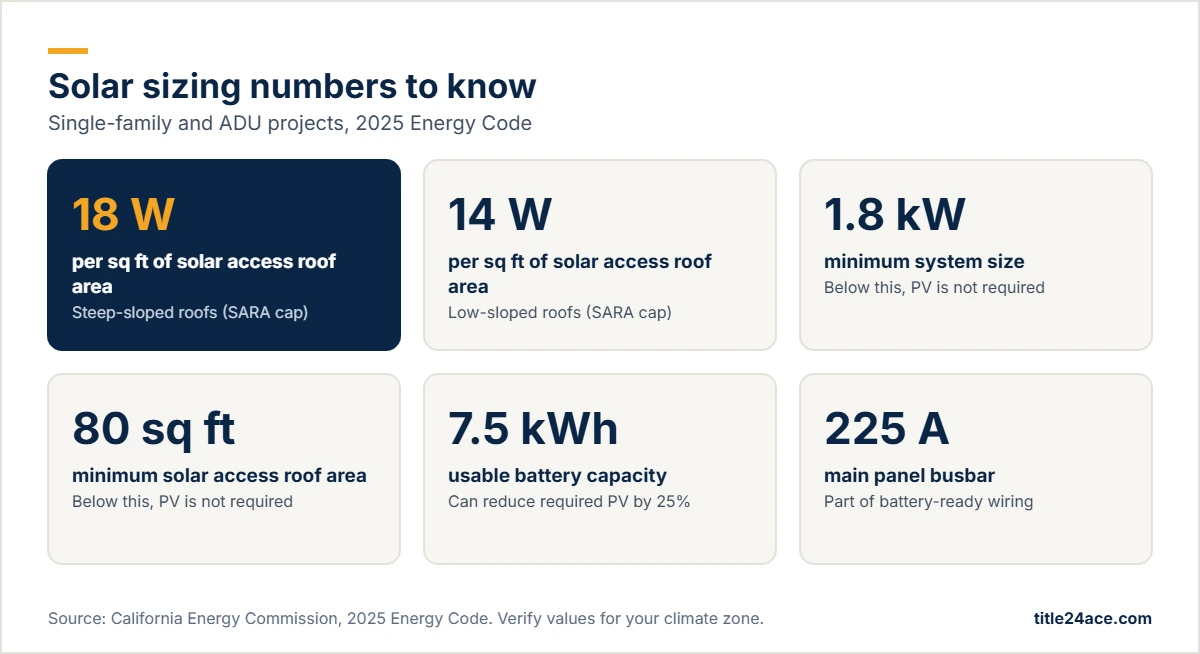
- 18 watts per square foot of SARA for steep-sloped roofs
- 14 watts per square foot of SARA for low-sloped roofs
That stops a shaded or small roof from being held to an unrealistic system size.
When solar isn’t required
For small homes and ADUs, the code has practical exceptions. Training materials on the 2025 code note that PV isn’t required when:
- the calculated system size is under 1.8 kW, or
- the solar access roof area is under 80 square feet.
Pairing the system with a battery can reduce the required PV size. Training materials cite a 25% reduction with at least 7.5 kWh of usable battery capacity.
As an example, a 1,000 sq ft ADU in climate zone 6 needs roughly 1.8 kW, about six 300-watt panels. Your energy report will show the exact figure for your design.
Battery-ready homes (new for 2025)
Under Section 150.0(s), newly constructed single-family buildings with one or two dwelling units and an electrical service over 125 amps must be battery energy storage system (BESS) ready, unless a battery is actually installed. Battery-ready infrastructure typically includes:
- Either backed-up interconnection equipment (60 A minimum) or a dedicated raceway (at least 1 inch) from the main panel to a future battery location
- At least four identified backup branch circuits, such as the refrigerator, a lighting circuit near the main exit, and a bedroom receptacle
- A main panel with a 225 A minimum busbar and reserved space for a transfer switch
Coordinate this early with your electrical designer. It affects panel selection and the single-line diagram on your plans.
New multifamily buildings
New multifamily buildings use the same SARA multipliers (18 for steep-slope, 14 for low-slope roofs) under Section 170.2. Larger and high-rise multifamily buildings may also need battery storage, sized using equations and capacity factors in the code. Multifamily solar and battery sizing is one of the more complex parts of an LMCC or multifamily report, so plan for it at schematic design.
New commercial (nonresidential) buildings
Section 140.10 requires solar PV, and in many cases battery storage, for new nonresidential buildings. The 2025 updates include:
- Updated PV sizing formulas based on solar access roof area
- Higher capacity factors for libraries, hotels and motels, medical offices, restaurants, retail and grocery buildings
- New building types added to the tables (events and exhibits, religious worship, sports and recreation)
- No battery required in climate zone 1 for several building types, including schools, offices, warehouses and medical clinics
- An exception for small multitenant spaces under 2,000 sq ft with their own meter and HVAC
These requirements appear on the NRCC compliance forms. See our commercial Title 24 reports page for how we handle them.
Solar is part of the bigger picture
Solar doesn’t replace efficiency. The Energy Code still requires the building itself, including insulation, windows, HVAC and water heating, to meet the efficiency targets. Under the performance approach, extra PV or a battery can earn compliance credit, which can make it easier to keep a design feature such as a large window wall.
What to bring to your energy consultant
- A roof plan showing slope, orientation and any shading (trees, neighboring buildings)
- Your electrical service size and panel information
- Any planned battery, with its usable capacity in kWh
- Whether you plan to install solar now or only meet the minimum
Common solar mistakes on permit plans
- PV size on the plans doesn’t match the CF1R. The solar installer’s single-line diagram and the energy report must show the same kW. Mismatches are a frequent plan-check comment.
- Ignoring shading. Trees, chimneys and neighboring buildings reduce the solar access roof area. Document them, because they can lower the required system size.
- Forgetting battery-ready wiring. New homes with service over 125 A need the raceway or backed-up interconnection, identified backup circuits and a 225 A busbar panel, even if no battery is installed yet.
- Assuming an ADU is exempt. A detached new-construction ADU usually needs PV unless it falls under the small-system exceptions. A garage-conversion ADU doesn’t.
Frequently asked questions
Is solar required for a new ADU in California?
Usually, for a newly constructed detached ADU, unless the required system is under 1.8 kW or the solar access roof area is under 80 sq ft. ADUs created by converting a garage, or attached as additions, generally don’t need solar.
Is a battery required for a new home?
Not a battery itself. Newly constructed single-family homes with service over 125 A must be battery-ready. Installing a battery can reduce the required PV size and earns compliance credit.
Do I need solar for an addition?
No. The CEC’s 2025 guidance says PV requirements apply to newly constructed buildings, not additions or alterations.
Get the right PV size on your CF1R
Title24 Ace calculates the required PV and battery-ready details as part of every new-home and ADU report, so your solar installer and electrician work from the same numbers. Get an instant estimate or contact us about a multifamily or commercial project.
This article summarizes California Energy Commission and Energy Code training resources for the 2025 Energy Code. It is general guidance. Exact requirements depend on your design, and the building department makes the final determination.