Title 24 for home additions: 2025 California Energy Code requirements
Home additions in California must meet Section 150.2(a) of the 2025 Energy Code. Window area limits depend on the addition's size, any new heating must be a heat pump, additions of 1,000 sq ft or less skip whole-house ventilation, and solar is not required.
Adding a bedroom, a primary suite, a second story or an attached ADU? In California, any addition that creates new heated or cooled space must comply with the Energy Code (Title 24, Part 6). The rules are in Section 150.2(a). The 2025 Energy Code, which applies to permits submitted on or after January 1, 2026, made a few important changes.
What counts as an addition?
An addition is any change that increases a building’s conditioned floor area and volume. That includes:
- Room additions and bump-outs
- Second-story additions
- Attached ADUs that share a wall, floor or ceiling with the house
- Converting an unconditioned space, such as a garage, attic or porch, into living space (see our garage conversion guide)
Remodeling space that is already conditioned is an alteration, not an addition.
Three ways to comply
- Addition alone, prescriptive: the new space meets every listed requirement.
- Addition alone, performance: the new space is computer-modeled and can trade stronger features against weaker ones.
- Existing + addition + alteration (performance): the whole house is modeled. Upgrades to the existing home, such as new windows, attic insulation or a heat pump, can earn credit toward the addition. This is often the best option when an addition has a lot of glass.
All three produce a CF1R Certificate of Compliance for your permit.
Key 2025 requirements for additions
Window area depends on the size of the addition
Under the prescriptive approach, the 2025 code allows more glass for smaller additions:
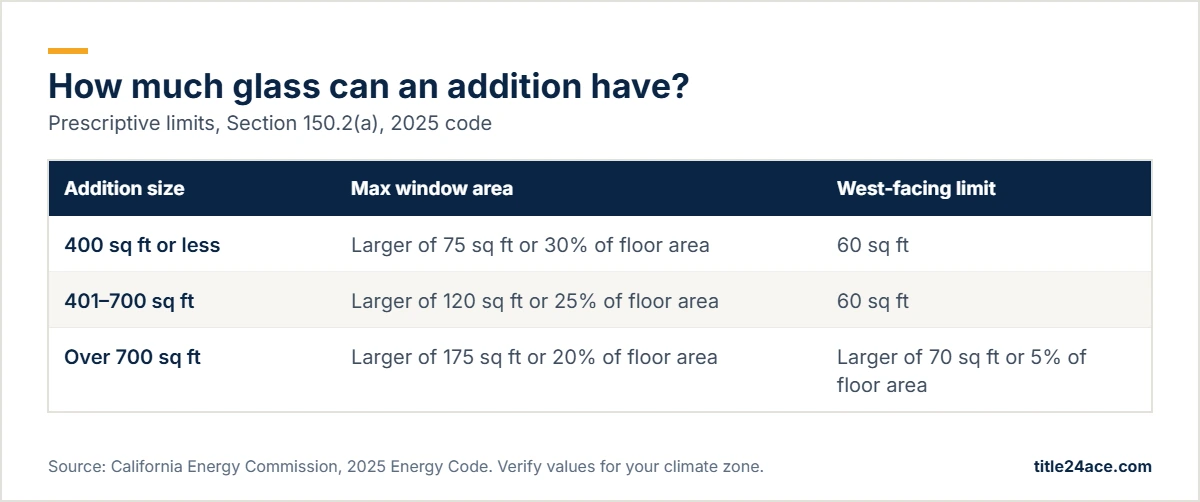
New windows must also meet the U-factor (about 0.27 or 0.30 by climate zone) and SHGC (about 0.23 in cooling zones) limits. More glass than this? A performance model is usually the answer.
Insulation
- Walls: R-15 in 2×4 walls or R-21 in 2×6 walls is the typical target for larger additions.
- Ceilings: about R-38 for vented attics in climate zones 1, 2, 4 and 8–16, and R-30 in zones 3 and 5–7, with a radiant barrier in many zones.
- Roofing: if the addition adds more than 300 sq ft of new roof, cool-roof requirements can apply in the hotter climate zones.
Heating and cooling: heat pumps are now the rule
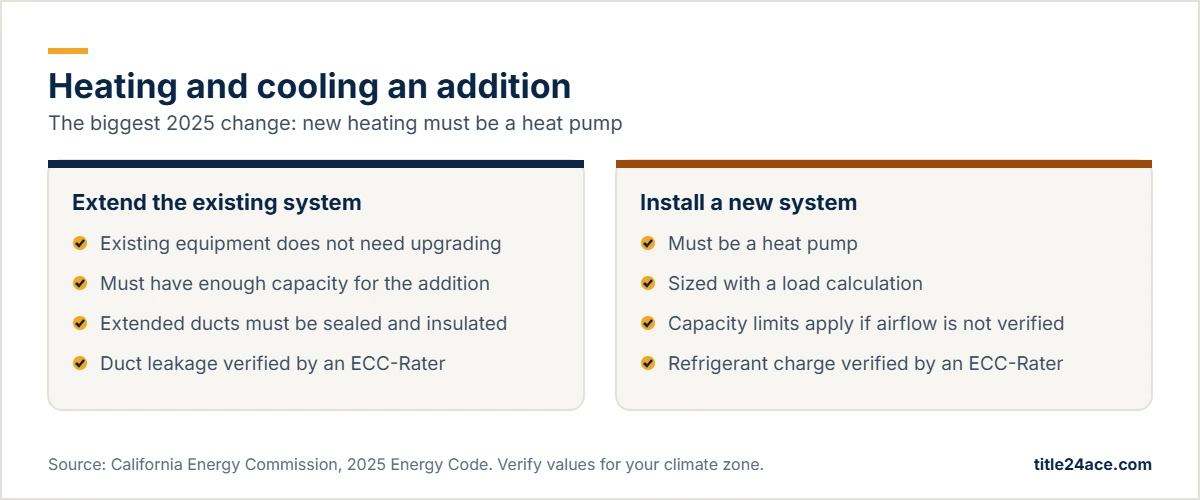
This is the biggest 2025 change for additions. New or replacement space heating serving an addition must be a heat pump. The previous exception was removed. Your options are:
- Extend the existing system: the existing equipment doesn’t have to be upgraded, as long as it has enough capacity. Any extended ducts must meet sealing and insulation requirements.
- Add a new system: it must be a heat pump, sized with a load calculation. New capacity limits apply when airflow isn’t verified, and the refrigerant charge must be verified by an ECC-Rater.
Water heating
Gas water heating was removed as a prescriptive option for additions. An additional water heater should be a heat pump water heater. For additions of 500 sq ft or less, an electric point-of-use heater is allowed. A gas water heater can still be used through the performance approach.
Ventilation
Additions of 1,000 sq ft or less are generally exempt from the whole-house mechanical ventilation requirement. New bathrooms and kitchens still need code-compliant exhaust fans.
Solar usually isn’t required
The CEC’s 2025 guidance states that solar PV requirements apply to newly constructed dwellings, not to additions or alterations. Adding solar voluntarily can still help a performance model comply.
Field verification (ECC)
Many addition measures are field-verified by an independent ECC-Rater (formerly a HERS Rater), such as duct leakage, refrigerant charge and airflow. The CF1R lists exactly which tests apply. Read how ECC verification works to plan the timing.
Worked example: a 450 sq ft primary suite
A family in San Jose (climate zone 4) adds a 450 sq ft primary bedroom and bathroom at the back of the house:
- Glass: at 401–700 sq ft, the addition can have the larger of 120 sq ft or 25% of floor area (about 113 sq ft), so 120 sq ft. West-facing glass is capped at 60 sq ft. The design’s 140 sq ft of sliding doors and windows is over the limit.
- Solution: instead of shrinking the doors, the energy consultant models the existing house plus the addition. Adding R-38 to the existing attic and sealing the existing ducts offsets the extra glass.
- HVAC: the existing furnace has enough capacity, so the ducts are extended, sealed and verified by an ECC-Rater. No new equipment is needed.
- Result: one CF1R covering the existing house, the addition and the alterations, with the doors the owners wanted.
Common addition plan-check comments
- Window area or west-facing glass over the prescriptive limit, with no performance model
- New heating equipment that isn’t a heat pump
- No load calculation for a new HVAC system
- Extended ducts without sealing and insulation notes
- Window U-factor and SHGC values missing from the window schedule
Frequently asked questions
Does a small addition need a Title 24 report?
Yes. Any addition that adds conditioned space needs Title 24 compliance documentation, even a small bump-out. Smaller additions get more relaxed window limits.
Can I keep my gas furnace if I add a room?
Yes, if you extend your existing system and it has enough capacity. If you install new heating equipment for the addition, the 2025 code requires a heat pump.
Is solar required for a second-story addition?
Generally no. PV requirements apply to newly constructed homes, not to additions. Check for any local reach code.
Get your addition’s Title 24 report
Title24 Ace prepares Title 24 reports for home additions anywhere in California. When it helps, we model the whole house so you get the most design freedom for the lowest upgrade cost. See your price instantly.
This article summarizes California Energy Commission guidance for the 2025 Energy Code. It is general information. Values vary by climate zone, and your building department makes the final determination.
Related reading
This article is general information, not professional or legal advice. Always confirm requirements with your building department.
Ready to get your Title 24 report?
Upload your plans in minutes. We’ll handle the modeling, the forms and the plan-check revisions.